Six Confessions, Zero Relief: Florida Supreme Court Shuts Door On Death Row InmateMaria Hernandez Mon, October 26, 2026 at 3:33 PM UTC

Samuel “Jason” Derrick
The Florida Supreme Court has rejected an appeal from death row inmate Samuel “Jason” Derrick seeking a review of newly presented evidence in his 1987 capital murder conviction, according to his defense attorneys.
Derrick was sentenced to death for the fatal stabbing of store owner Rama Sharma. His defense team contends that recently uncovered witness accounts show another man, Michael “Craze” Keesling, confessed to the killing to at least six people before his death in 2009.
Julie Morley, an assistant federal public defender with the Office of the Federal Defender for the Middle District of Florida, issued a statement condemning the court’s decision.
“We are deeply disappointed by the Supreme Court of Florida’s refusal to consider newly discovered evidence in Jason’s case that supports what he has said since he was first arrested for the murder of Mr. Sharma more than thirty-five years ago: he is an innocent man,” Morley said. “The Court resorted to legal gymnastics and selective fact-finding to uphold a wrongful conviction rather than confront the evidence and rectify a grave injustice. We will not stop fighting to prove Jason’s innocence.”
According to defense filings, Keesling had a documented history of violence, regularly carried a knife matching the type used in the murder, and had an ongoing dispute with Sharma. The defense team gathered statements from multiple acquaintances who reported hearing Keesling admit to the crime over a two-decade span.
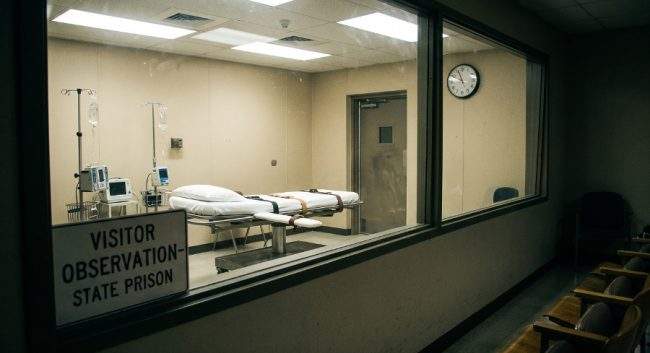
Execution Chamber
Among the newly cited witness accounts, Claude “Butch” Parker told investigators that Keesling admitted to fighting with Sharma during the incident and claimed he discarded the murder weapon where authorities would never locate it. Another witness, Cecile Huff, stated that Keesling told her “Jason took the bullet” and that the knife would never be found.
Acquaintance Kevin Melady reported that Keesling claimed responsibility for the killing, stating that Derrick was on death row “for something he didn’t do.” Additional statements collected from witnesses Dawn Fayne, Thomas Kavanaugh, and Barbara Snapp similarly described Keesling taking credit for the stabbing.
Derrick was 21 years old at the time of his conviction. His defense argues that no physical evidence, DNA, or murder weapon linked him to the scene, and that the prosecution’s case relied on a confession obtained under duress.
Attorneys state that police subjected Derrick to an extensive, overnight interrogation and threatened that he would never see his newborn son again—a circumstance the defense argued was especially coercive because Derrick had survived abuse while in foster care. His legal team maintains that the details in Derrick’s initial statement contradicted physical evidence from the crime scene and the victim’s manner of death.
In their release, Derrick’s defense team pointed to broader systemic concerns, noting that false confessions are a leading cause of wrongful convictions nationwide. The team also cited records showing that 30 death row inmates in Florida have been exonerated since 1973.
READ: Central Florida Woman Chased Down By Bystanders After Dousing Man With Accelerant, Setting Him On Fire
Please make a small donation to the Tampa Free Press to help sustain independent journalism. Your contribution enables us to continue delivering high-quality, local, and national news coverage.
Sign up: Subscribe to our free newsletter for a curated selection of top stories delivered straight to your inbox.
Six Confessions, Zero Relief: Florida Supreme Court Shuts Door On Death Row Inmate
Source: Crime



0 Comments